By Itamar Batista, editor of the TETO Brasil blog
The sun hasn’t come up yet when the teams meet, somewhere between 5:30 and 6 a.m., in Jardim Lapenna. It’s a Saturday in April 2025. The neighborhood is only just stirring, with someone sweeping their front step or a radio playing low in the distance, but most of the people who live here left home long ago.
At this hour, Waldiney, known to everyone as Smyth and a resident of Jardim Lapenna for the past ten years, is already up too. Unlike most of his neighbors, though, he’s awake for a different reason: in a few hours, he’ll meet the team of TETO Brasil volunteers who will build a home alongside him for himself and his 12-year-old son, Cauê.
A little earlier, around 4:30 a.m., personal trainer Estefani Melo is waking up at the Indir Jardim Lapenna childcare center, next door to the Galpão ZL , the space lent out to house TETO Brasil volunteers for the nights of the build. This is Estefani’s first construction, and she’s one of the people Smyth will get to know over the next 48 hours.
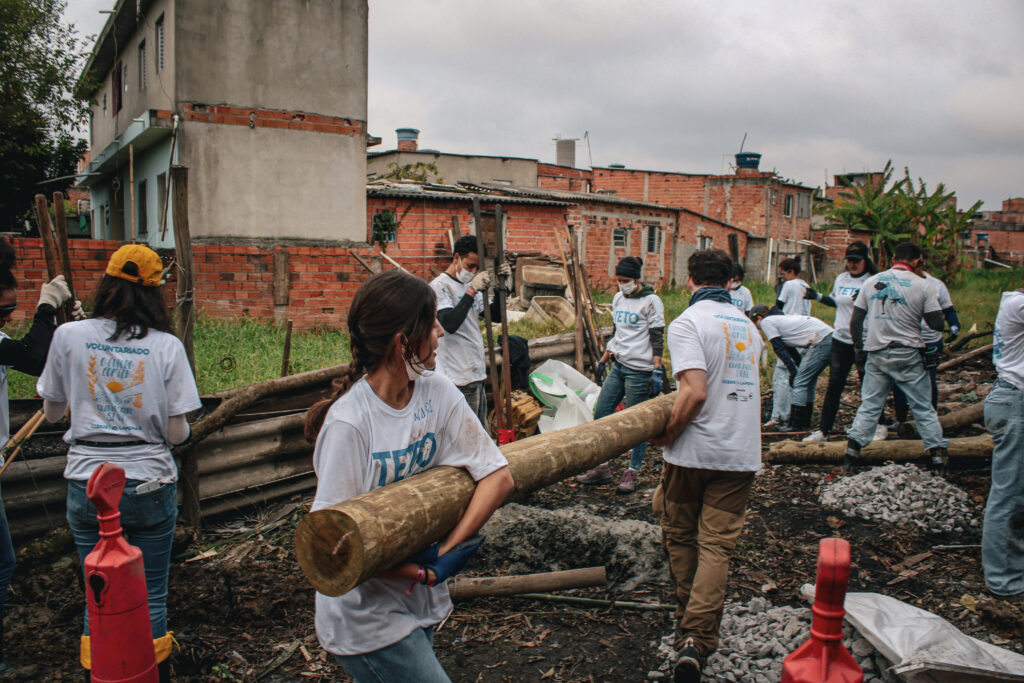
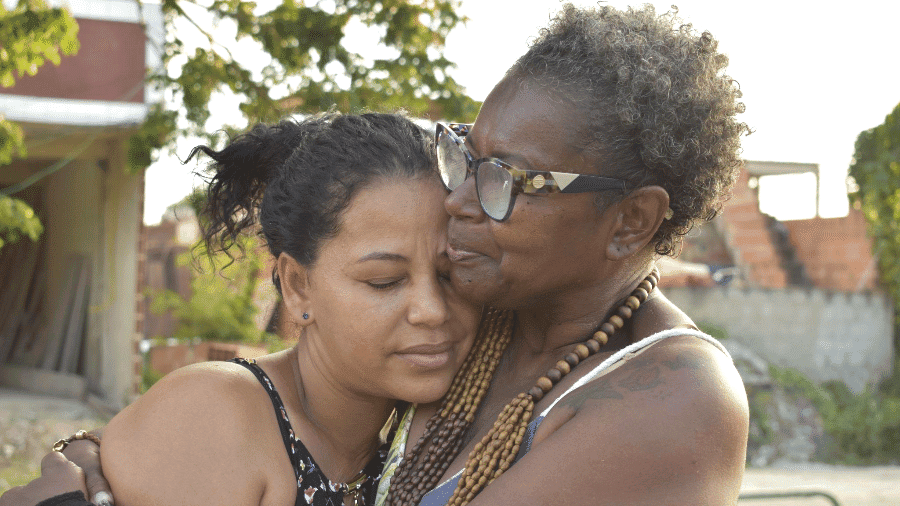
The volunteers reach the site around 6 a.m., the light still low and gray. Before a single tool touches the ground, everyone introduces themselves and shares a bit of their story: it’s the moment two lives that had never crossed, like Smyth’s and Estefani’s, start sharing the same work, hammering nails, raising panels, and, eventually, putting up a home. That’s where the two met, and the friendship they built has held ever since, rooted in the piles beneath the house Estefani helped him build.
TETO Brasil’s operations manager, Lais Duanne, says that once volunteers and neighbors have had that first moment of connection, the tape measures come out at 7 a.m. The house’s position is measured, then checked with the family before a single mark goes on the ground. “We confirm the house’s placement on the lot several times before we ever start building,” she says.
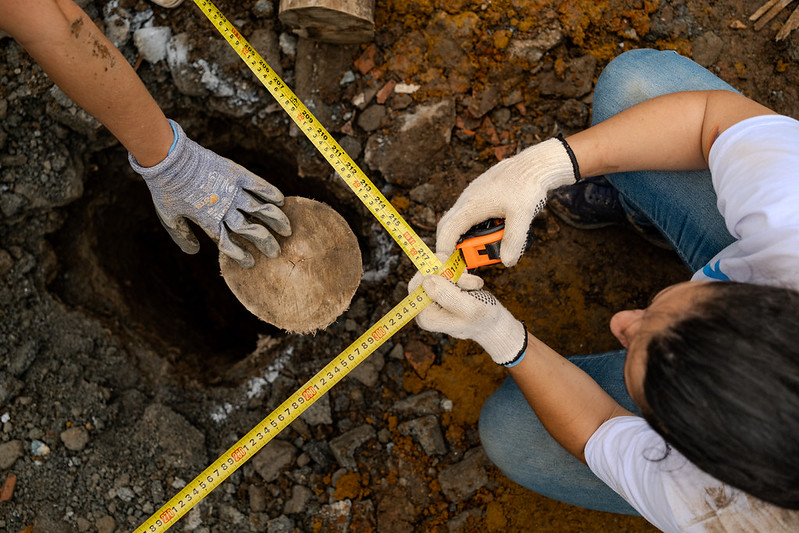
Breaking ground
Once the layout is marked, it’s time to lay the foundation. Twelve holes are dug by hand, one after another, each one meant for a pile that will help hold the house up. The first morning is given over almost entirely to this work, since it’s what keeps everything else standing later on. “We hit it off right from the piles, right at the start,” Estefani says. “Smyth warmed up slowly, in his own way, but he kept edging closer, and that mattered. It showed he was really there to build the house with us, not just watch it happen.” Between digging and setting piles, the sun climbs higher, and before long it’s time for lunch.
Each stage of the build comes with a small ceremony that renews the point of the whole thing. The final nail securing the floor, for instance, is driven in together: everyone circles the hammers around it and takes turns striking, each swing carrying a wish for the family who’ll live there. “We put the hammers around the nail and each person gets a turn. We’re wishing good things onto the family who’s going to live there,” Estefani explains. In a way, those wishes become part of the foundation itself, a reminder of what a home means in someone’s life. The last blow always goes to the person, or family, who will build the rest of their story on that new floor.
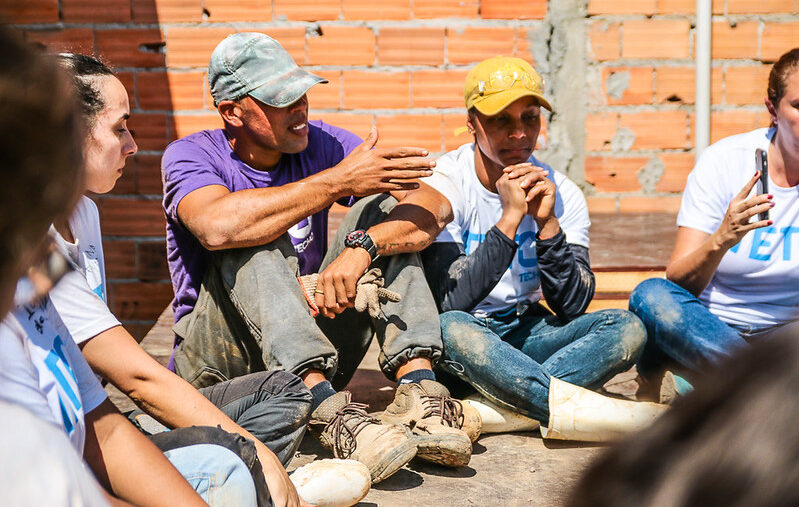
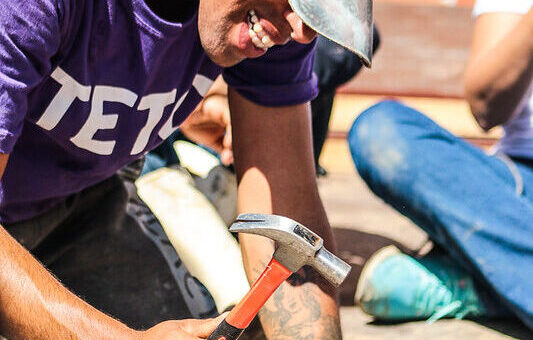
Smyth still remembers, clearly, that last nail going into his floor. “I remember the wishes people made,” he says. “So many of them, one after another, and every single one stuck with me. I looked into the eyes of the volunteers and I could tell each wish was coming straight from the heart.” Listening to people wish him and his son well, Smyth felt something settle into place inside him, the same way the nail settled into the floor. “It made me fall even harder for what TETO does,” he says.
By the time the foundation is finished, the sun is already low, almost down over the neighborhood. The team packs up and heads out around 5:30 p.m., usually to lodging somewhere nearby.
At night, there’s no hammer, no tape measure. The kitchen crew puts together dinner for volunteers and residents alike, and everyone sits down together, with no rush to set a pile or drive a nail, to talk about anything else: family, work, the neighborhood, what brought each of them there that weekend.
Day two
Work picks up again on day two with the first light, somewhere between 5 and 6 a.m., now focused on walls and roof. With the foundation already in, the house starts taking real shape. The wall panels go up through the morning, and by lunchtime the frame that will carry the roof is already standing.
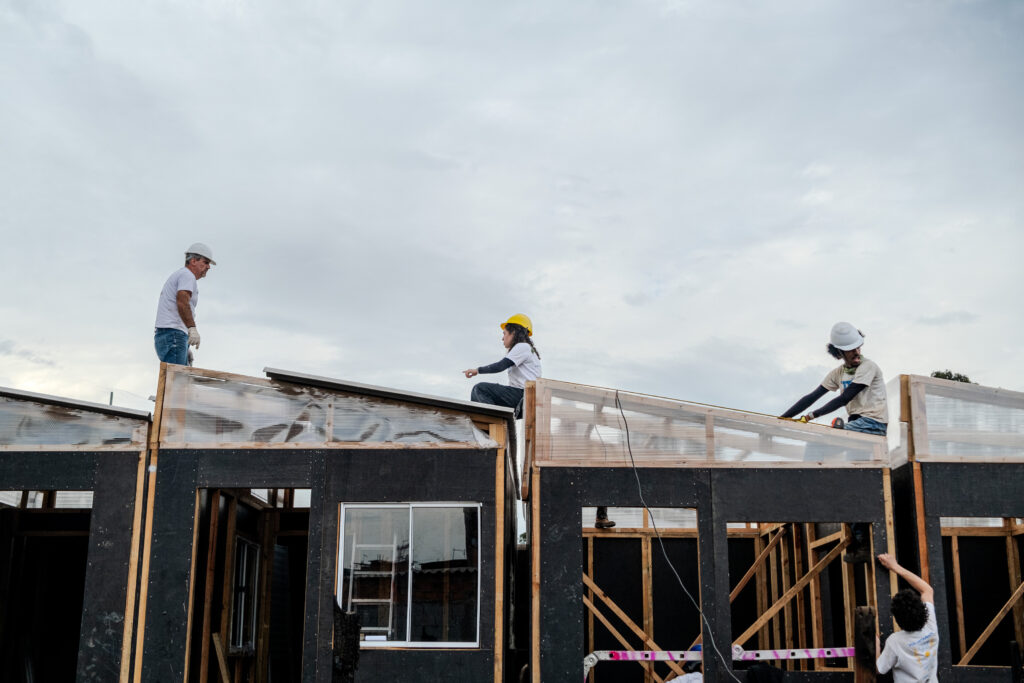
After lunch, the crew puts on the roof, hangs the doors and windows, and adds a set of steps if the house needs one. By the time the weekend’s second sunset settles over the neighborhood, what had been an empty lot two days earlier is a finished home.
TETO Brasil’s operations manager, Laís Duanne, says this same sequence plays out build after build, neighborhood after neighborhood, but never quite the same way twice. “Every family, every volunteer, brings their own hopes to the home going up over those 48 hours. The schedule barely changes, give or take a few adjustments, but what gets said at each ceremony is always new, and it always points back to the same thing: that everyone deserves a decent place to live, and that takes all of us organizing for it.”
TETO’s presence in Jardim Lapenna goes back long before this particular 48-hour build, long before Estefani and Smyth ever met, in fact. Surveys, interviews and site assessments with residents help the team read the neighborhood and, together with the community, settle on exactly where each home should go. In the days right before the build, the real groundwork begins: volunteers haul the materials in and stash them somewhere close to the site, ready to go. And once the house is up, once Smyth and Cauê are already sleeping under their new roof, one last step wraps things up: painting, the finishing touch that makes it a home.
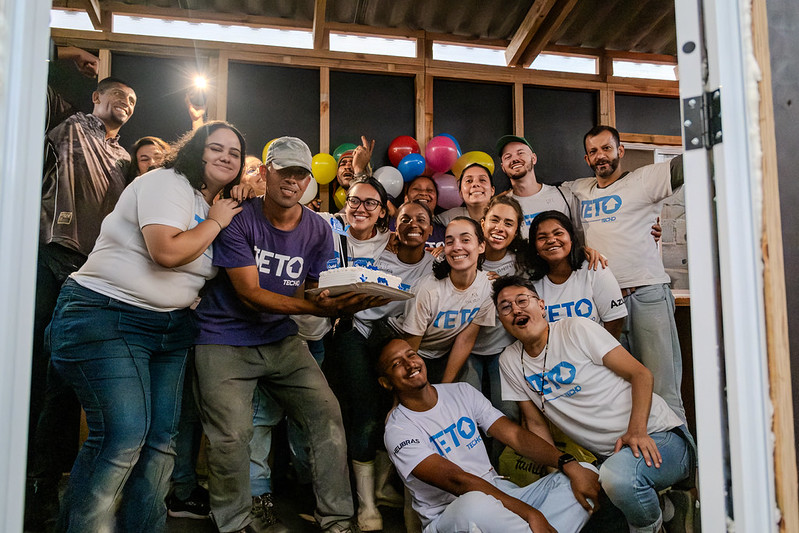
The friendship between Estefani and Smyth didn’t end when the house was handed over. “We still have a WhatsApp group going, and everyone who worked on this house is in it,” she says. “Whenever there’s a new TETO build, Smyth messages the group, and we all write back.” Smyth went on to become a volunteer himself, helping build other houses in the neighborhood after his own, and later joined a build in Vilinha, in Itapevi, too. “It’s really something, seeing him keep coming back to a thing he believes in, something that means something to him, that changed his life,” Estefani says. “These unlikely friendships, these chance meetings, people I never would have met, volunteers and Lapenna residents alike, if I hadn’t gotten involved.”
Help build a home
You can help put up new homes in as little as 48 hours, just like the ones in Jardim Lapenna. Head to the donations page on the TETO Brasil website and pick whatever works for you, whether that’s a one-time gift or a monthly commitment.